Asbestos Encapsulation Using Closed Cell Spray Foam Insulation
The Definitive Technical, Regulatory and Commercial Guide for Industrial, Commercial and Agricultural Buildings

Introduction: The Ongoing Asbestos Challenge in the UK
Asbestos remains one of the most significant legacy risks within the United Kingdom’s built environment. Although fully banned in 1999, asbestos containing materials are still present in a substantial proportion of commercial, industrial and agricultural buildings constructed before 2000.
For duty holders, property owners and facilities managers, the objective is not automatic removal. It is compliant, proportionate and technically sound management under the Control of Asbestos Regulations 2012.
Closed cell spray polyurethane foam has emerged as one of the most advanced solutions for asbestos cement roof encapsulation. When properly specified and installed by trained professionals, it delivers fibre containment, condensation control, structural reinforcement and thermal upgrade in a single engineered system.
See Asbestos Encapsulation in Action
Watch our team apply closed cell spray foam directly to corrugated asbestos cement roof sheets, sealing fibres and delivering a seamless monolithic layer in a single application.
Understanding the Legal Duty to Manage
Regulation 4 of the Control of Asbestos Regulations 2012 places a clear Duty to Manage on those responsible for non domestic premises. This requires identification of asbestos containing materials, assessment of their condition, maintenance of an up to date asbestos register and implementation of appropriate control measures.
Importantly, the regulations do not require removal in every circumstance. Where asbestos cement sheets are stable and undamaged, encapsulation is widely recognised as a lower risk solution compared to removal, which inherently creates dust and potential fibre release.

Encapsulation Versus Removal: A Strategic Decision
Full Removal
✗ Generates significant dust and fibre disturbance
✗ Requires specialist licensing in most cases
✗ Extended building downtime and disruption
✗ High disposal and re-cladding costs
✗ Complex project management and sequencing
Spray Foam Encapsulation
✓ Stabilises asbestos fibres safely in situ
✓ No mechanical fixings or drilling required
✓ Building can remain operational during works
✓ 70–90% cost saving vs full removal
✓ Single application delivers multiple benefits
Why Closed Cell Spray Foam is Technically Superior

Closed cell spray polyurethane foam is fundamentally different from thin film paint coatings. It is applied as a liquid that expands rapidly and bonds directly to the asbestos substrate, creating a seamless and monolithic layer.
This bond follows corrugated or irregular roof profiles precisely and requires no mechanical fixings. No drilling into asbestos sheets is required, which removes one of the primary triggers for fibre disturbance.
• Direct Bond to Substrate: The foam adheres permanently to the asbestos cement surface, sealing any surface cracks and encapsulating loose fibres without the need for fixings or drilling.
• Seamless Monolithic Layer: The foam expands into all irregularities, eliminating cold spots, air gaps and moisture pathways.
• No Fibre Disturbature: No cutting, drilling or mechanical fixing through the asbestos sheet means the primary risk of fibre release is eliminated.
Thermal Performance and Building Regulations Part L
Closed cell foam typically delivers thermal conductivity values between 0.026 and 0.028 W per metre Kelvin. This allows significantly higher thermal resistance per millimetre compared to mineral wool or open cell insulation.
By increasing the overall thermal resistance of the roof build up, closed cell foam enables compliance with increasingly stringent Part L requirements while preserving internal height and avoiding heavy structural upgrades.
0.026
W/m·K Thermal Conductivity
Part L
UK Building Regulations Compliant
70–90%
Cost Saving vs Full Removal
Condensation Control in Single Skin Asbestos Roofs
Single skin asbestos cement roofs are highly susceptible to condensation. Warm internal air rises and meets the cold sheet, leading to moisture formation, dripping and long term damp conditions.
Closed cell spray foam acts as both an air barrier and vapour retarder. By raising the internal surface temperature above dew point and preventing moist air from reaching the cold substrate, it effectively eliminates interstitial condensation.
Technical Specification
Closed cell spray foam achieves a vapour resistance factor significantly exceeding BS 5250 requirements for managing condensation in single skin roof structures. This eliminates the need for separate vapour control layers and simplifies the overall roof build up.

Structural Reinforcement and Wind Uplift Resistance
Aging asbestos cement sheets can become brittle and vulnerable to wind uplift. When closed cell spray foam bonds to the internal face of the roof, it effectively locks the sheets together and distributes loads more evenly.
Independent industry testing has demonstrated significant improvements in wind uplift resistance and racking strength following application. For older industrial units and agricultural buildings, this can extend the functional lifespan of the structure by decades.
▪
Composite Strength
Bonds sheets into a reinforced composite assembly
▪
Wind Uplift
Distributes loads more evenly across the roof structure
▪
Lifespan Extension
Extends functional lifespan of existing roof by decades
▪
Surface Integrity
Fills cracks and voids in aging sheets
Cost Analysis: Encapsulation Compared to Removal
Encapsulation typically ranges between £30 and £45 per square metre depending on project size and complexity. Full removal and re-cladding can exceed £135 to £235 per square metre once disposal, scaffolding and replacement materials are included.
Full Removal & Re-cladding
£135–235
per m² including disposal & scaffolding
Spray Foam Encapsulation
£30–45
per m² — building remains in use
Typical Saving
70–90%
reduction on large industrial roofs
Land Remediation Relief and Corporation Tax Benefits
UK limited companies may qualify for Land Remediation Relief when remediating contaminated property acquired from a third party. This allows a deduction of up to 150 percent of qualifying expenditure against taxable profits.
For profitable companies, this significantly reduces the effective cost of asbestos encapsulation. For loss making companies, a payable tax credit may be available, improving cash flow.
Financial Planning Note
The availability and quantum of Land Remediation Relief depends on individual company circumstances. Duty holders should seek specialist tax advice to assess eligibility and maximise the financial benefit available for qualifying encapsulation projects.

Fire Performance and Certification
Professional closed cell systems used in the UK must achieve appropriate fire classifications. High quality systems can achieve Class 1 surface spread of flame and suitable roofing fire ratings where required.
Where necessary, additional protective coatings or thermal barriers can be incorporated to ensure compliance with building control and insurer requirements.
✓
Class 1 surface spread of flame to BS 476 Part 7
✓
Intumescent coatings available for enhanced fire classification
✓
Compliant with building control and insurer requirements
Professional Installation and Quality Assurance

Successful encapsulation depends entirely on professional execution. Power washing asbestos surfaces is strictly prohibited. Controlled cleaning methods must be used to avoid fibre release.
Installers must follow temperature specific application guidelines, adhere to maximum pass thickness limits and implement strict health and safety protocols.
• Pre-installation asbestos condition survey
• Controlled surface cleaning — no power washing
• Temperature and humidity monitoring throughout
• Application in controlled passes with cure time between layers
• Post installation thickness verification
• Written certification and compliance documentation for the asbestos register
Sustainability and Modern Low GWP Technology
Modern closed cell foams increasingly utilise low global warming potential blowing agents. This significantly reduces environmental impact compared to earlier formulations.
Encapsulation also avoids the environmental burden associated with asbestos removal and landfill disposal. By preserving existing building fabric and improving operational energy efficiency, it represents a sustainable pathway aligned with UK net zero objectives.
Conclusion: A Technically Robust and Commercially Intelligent Solution
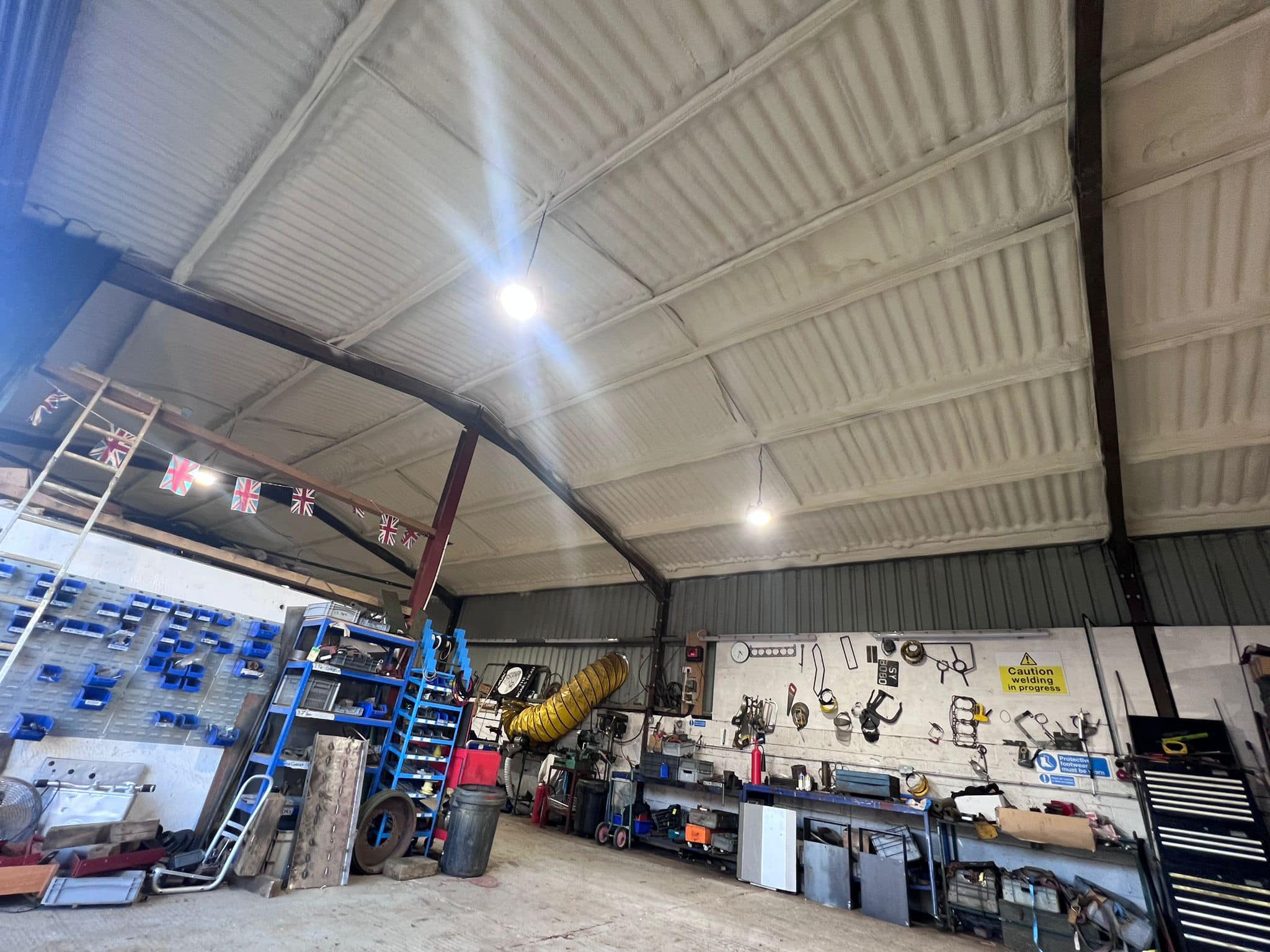
Closed cell spray foam asbestos encapsulation provides a comprehensive solution that integrates safety, compliance, structural enhancement and energy performance.
For industrial, commercial and agricultural property owners managing stable asbestos cement roofs, professional encapsulation represents the most technically balanced and economically responsible strategy available in the United Kingdom today.
At Spray Foam Tech, we specialise in closed cell spray foam systems designed for asbestos cement encapsulation across industrial, commercial and agricultural buildings. From initial condition assessment and specification support to professional installation and full compliance documentation, we manage every stage of the process.
Managing an asbestos cement roof? Let us help you deliver a compliant, cost effective and technically sound solution. Get in touch today for expert advice and a tailored project quote.